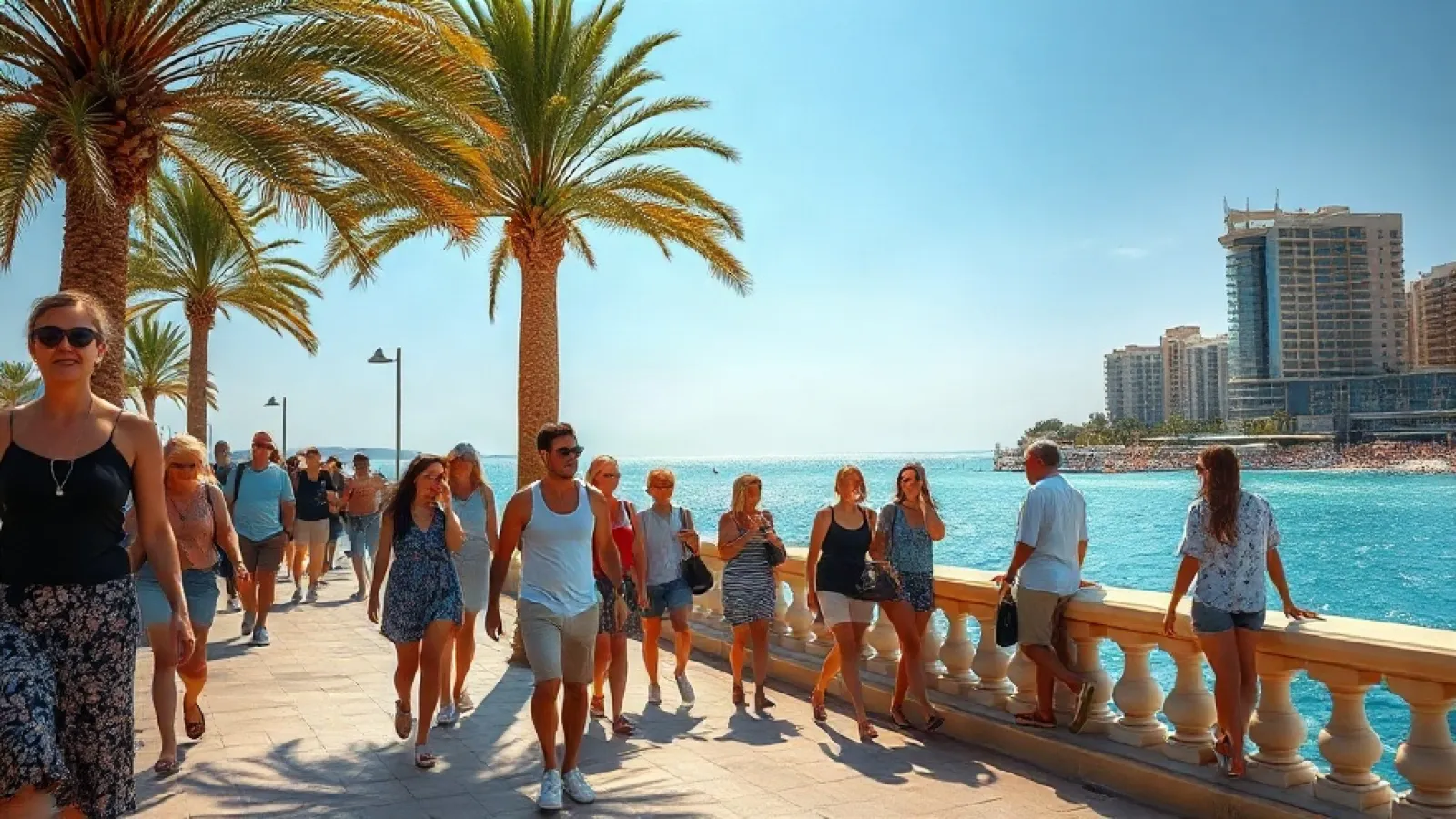
Greece’s tourist accommodation sector posted another year of growth in 2025, with arrivals reaching 38.2 million and overnight stays totalling 156.3 million, according to final data released by the Hellenic Statistical Authority (ELSTAT) on 27 July 2026.
Compared with 2024, arrivals at hotels, similar establishments, tourist campsites and registered short-stay accommodation increased by 2.8 percent, while overnight stays rose by 2.2 percent. The annual hotel bed occupancy rate remained broadly stable at 50.7 percent, versus 50.6 percent a year earlier.
Growth was driven by both domestic and international travellers. Non-resident arrivals increased by 2.9 percent and resident arrivals by 2.4 percent; overnight stays rose by 2.2 percent and 2.1 percent, respectively. The figures mark a fifth consecutive year of expansion following the sharp pandemic downturn, with both arrivals and overnight stays reaching their highest levels of the 2020-2025 period.
International demand dominates
Foreign visitors continued to dominate, accounting for 73.8 percent of all arrivals and 83.8 percent of overnight stays. Europe remained the largest source market, generating 80.6 percent of foreign arrivals and 89 percent of overnight stays. EU member states contributed 53 percent of arrivals and 58.1 percent of overnight stays.
Germany was Greece’s largest EU source market, representing 12.7 percent of foreign arrivals and 16 percent of overnight stays. The United Kingdom, a non-EU European market, led with 16.4 percent of arrivals and 19.4 percent of overnight stays.
Among the fastest-growing source markets, Bulgaria recorded an 8.4 percent increase in arrivals and an 11.5 percent rise in overnight stays. Arrivals from Serbia increased by 11.4 percent and from China by 9.8 percent.
Regional performance
The South Aegean and Crete remained Greece’s leading tourism regions, together accounting for 39.5 percent of total arrivals and 49.3 percent of overnight stays across all accommodation establishments. Attica represented 15.3 percent of arrivals, followed by Central Macedonia with 12.5 percent. The Ionian Islands accounted for 13 percent of all overnight stays.
The Ionian Islands also recorded the highest annual hotel bed occupancy rate at 59.7 percent, followed by Crete (54.9 percent), the South Aegean (51.8 percent), Central Macedonia (51.6 percent) and Attica (51.2 percent).
In absolute terms, the largest increases in arrivals were recorded in Central Macedonia, the Peloponnese and the Ionian Islands. By percentage, the North Aegean recorded the strongest increase (7.9 percent), followed by the Peloponnese (6.8 percent) and Western Greece (6.6 percent).
Seasonality persists
Tourism activity remained heavily concentrated in the summer season. Between July and October, Greece recorded 56.7 percent of annual arrivals and 63.7 percent of overnight stays. August alone accounted for 19 percent of arrivals and 21.7 percent of overnight stays.
Nationally, hotel bed occupancy averaged 50.7 percent in 2025 but peaked at 81.3 percent in August, underscoring the continued concentration of demand during the peak summer months.
Why it matters
The record figures confirm that Greece’s accommodation sector has fully recovered from the pandemic and is now operating at historically high volumes. For tour operators and bedbanks, the data points to sustained demand from core European markets, particularly Germany and the UK, while emerging sources such as Serbia and China offer incremental growth opportunities. The persistent seasonality, with August occupancy exceeding 80 percent, reinforces the need for destination management strategies that spread demand across the shoulder months. Regional disparities also remain pronounced: the South Aegean and Crete continue to capture nearly half of all overnight stays, suggesting that investment and marketing efforts in less saturated regions such as the North Aegean and Peloponnese could yield above-average returns.