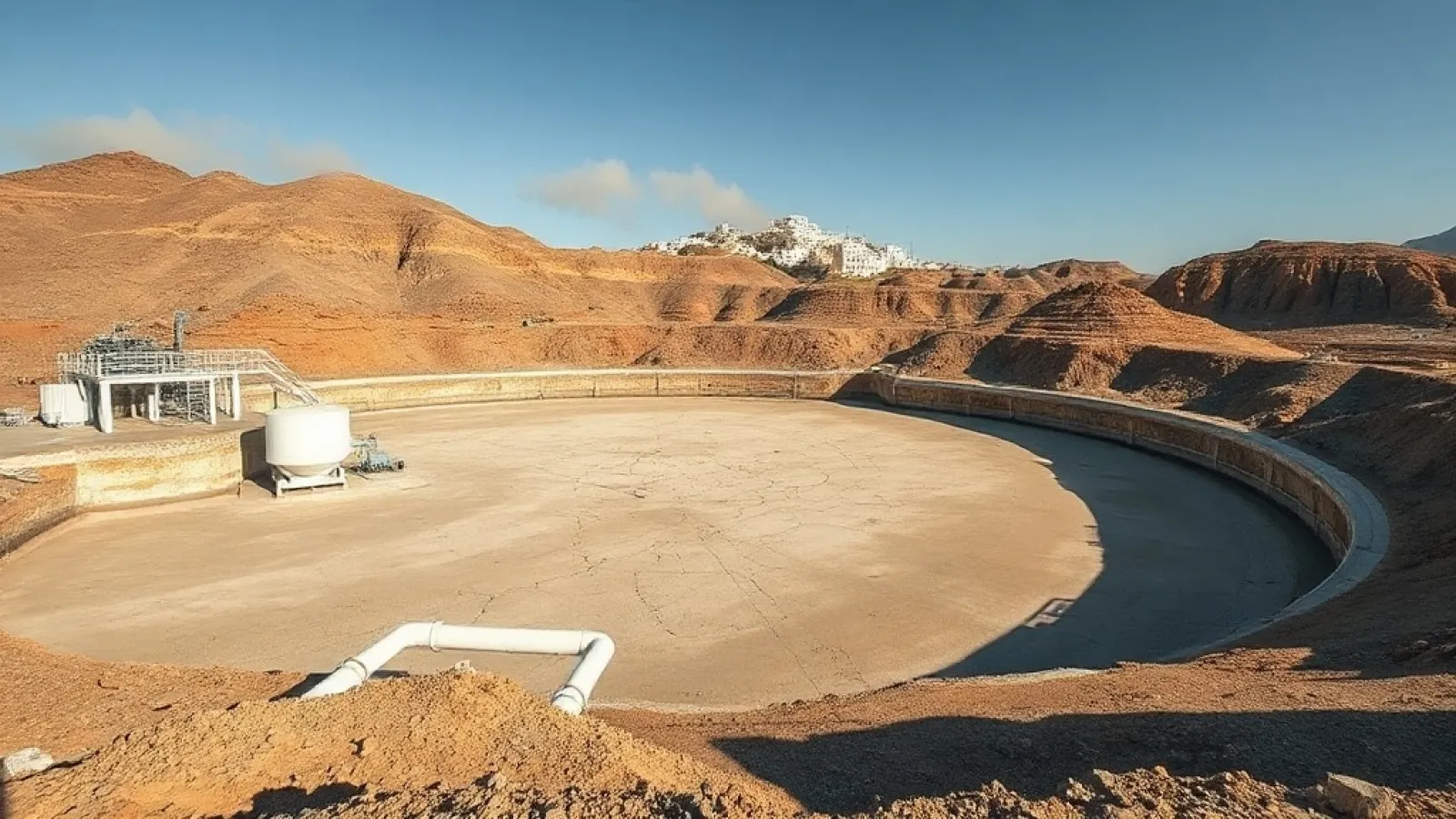
Seven Greek islands in the Aegean Sea have declared drought emergencies this year, as climate change intensifies summer heat and disrupts rainfall patterns, according to a Reuters report published July 16, 2026. The situation is most acute on Astypalaia, where the main reservoir holds just 150,000 cubic metres — a sixth of its capacity — after the island experienced its second-driest season since 2020.
Authorities on Astypalaia cut off irrigation for farmers in the Livadi area in April to preserve water for household use and the main tourist town of Chora. Daily summer consumption runs at about 900 cubic metres, meaning the reservoir would last roughly five and a half months without replenishment.
Mayor Nikos Komineas described the severity: "If we collected all the water dropped throughout the year in a bucket or in a washbowl, it would be 2.5 cm deep." He noted that a water emergency was declared in May to fast-track a temporary desalination plant with a daily output of 600 cubic metres for Chora. A second temporary facility was set up after the existing desalination plant in Analipsi could not cover the population, which swells to 7,000 from 1,400 in midsummer. A permanent desalination plant is planned for completion by the end of 2026.
The Copernicus European Drought Observatory map for June 2026 marked Astypalaia in orange, an early sign of emerging drought. Farmers like Evdokia Palatianou, 71, have been forced to rely on brackish well water after being cut off from the reservoir. "Unless it rains, I won't plant anything," she said, standing next to a dead mandarin tree in Livadi.
Some hoteliers are already adapting. Carolina Alkalai, who operates a hotel in Chora, offers guests a €5 voucher to skip daily cleaning service to save water. She envisions a second hotel on the island that would incorporate a rainwater cistern instead of a pool or jacuzzi.
Environment Minister Stavros Papastavrou has approved €15 million ($17 million) for desalination, grid upgrades and water tanks on nine inhabited islands, including €1.5 million for Astypalaia. In June, he briefed fellow EU environment ministers in Luxembourg on water resilience. "For Greece, water isn't theoretical — it's about security, economic growth and the protection of local communities," he said.
The National Centre for Scientific Research "Demokritos" in Athens warns that drought could worsen by 2049 as global temperatures rise, exacerbating water scarcity on vulnerable islands.
Why it matters
For the travel trade, the drought emergencies on seven Aegean islands signal a growing operational risk for peak-season tourism in Greece. The population on Astypalaia more than quadruples in summer, and the water infrastructure — reliant on a single reservoir and energy-intensive desalination — is stretched to its limit. Hoteliers are already implementing water-saving measures, but the cost of temporary desalination and the uncertainty of winter rainfall create planning challenges for DMCs, tour operators and investors. If drought persists, islands may face restrictions on visitor numbers or higher water costs, potentially affecting package pricing and destination competitiveness. The government's €15 million allocation for nine islands indicates that the issue is systemic, not isolated, and that long-term resilience investments will be needed to sustain tourism growth in the Greek islands.